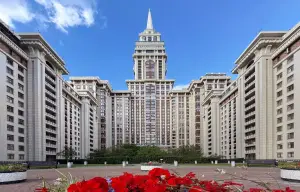
"House on Mosfilmovskaya" - the second tower in Ramenki after Moscow State University

One of my goals is to shoot all the iconic projects and locations in the cities where Whitewill sells real estate. Through photo stories, I try to capture the atmosphere and architectural details of these locations to help our clients find the right place to live or invest.

Sergey Skuratov’s controversial project—more on that below—set a new standard for high-rise architecture in Moscow in 2012.
It won six awards, including the “Arch Moscow” award and the international CTBUH Awards for the best high-rise buildings.


Sergey Skuratov demonstrated his own approach to building skyscrapers—not for offices in the City, but for everyday life in apartments on 30+ floors. Yes, without club amenities, but with a distinctive silhouette and picturesque views of the City, the river, and the Olympic Stadium nestled in greenery—Luzhniki.
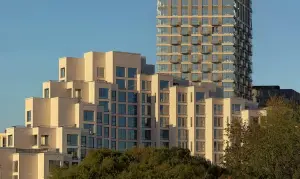
The new landmark—“The House on Mosfilmovskaya”—is the second tower rising above Vorobyovy Gory, visible to you as you speed along the Third Ring Road. The second-tallest after Moscow State University.
Skuratov mixed styles together like ingredients in a salad: Le Corbusier’s modernism with its “houses on legs,” the texture and form of Art Deco, and high-tech architecture with panoramic windows.
The result is two towers—52 and 32 stories high—with a shared atrium. The facades are jagged and mottled, made of stone and glass: dark at the bottom and light limestone and marble at the top.
Looking at them, you’d swear the building has risen up and is floating above Mosfilmovskaya Street. This effect is created by the 17-meter-tall legs of rough gray granite arranged in three zigzagging rows.


What’s the controversy?
In 2004, a 165-meter-tall project was approved, and construction began in 2006. During the process, Skuratov increased the height to 213 meters—even though Moscow State University is only 183 meters tall without its spire—and that’s when the questions started.
Wouldn’t this spoil the view from the Novodevichy Convent? In 2008, a request was sent to UNESCO—and they approved it. Construction continued, but the deadlines were constantly pushed back.
As early as 2010, the authorities wanted to classify the project as an unauthorized structure, arguing that the height had been increased illegally. They planned to tear down 22 floors. That’s when Moscow’s leading architects—Alexander Asadov, Pavel Andreev, Nikita Biryukov, Sergey Choban, and Mikhail Khazanov—wrote to the mayor. They have built one-third of all modern luxury real estate in the capital.
Ultimately, the project was completed in 2012—entirely according to the architect’s vision.


The best projects in Moscow:


A real town within a town. The upper town is eight apartment buildings. The historic buildings of the lower town house restaurants, stores, a kindergarten, an educational center, language schools, sports studios and a heated rooftop pool.
| Lots | Area from |
Price from
|


small_description
| Lots | Area from |
Price from
|


A premium-class complex consisting of two residential towers of 41 and 49 floors and a 6-storey commercial building. Residents will have access to a private landscaped area, a fitness club with a 25-meter swimming pool and a lounge at a height of 140 meters.
| Lots | Area from |
Price from
|
Read also: